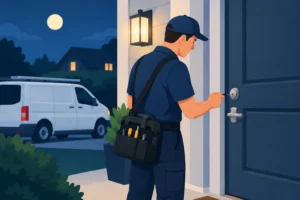


A property manager gets a call at 10 p.m.: a water leak is spreading behind a locked apartment door. The maintenance supervisor has a key, but it opens only the supply closet. A well-planned master key system guide helps prevent that kind of delay without giving every employee access to every door.
A master key system is not simply a collection of copies. It is an access plan built into the locks themselves. When designed correctly, it gives the right people entry to the spaces they need, limits unnecessary access, and makes daily operations easier for homes, offices, retail spaces, medical practices, and multi-unit properties.
What a Master Key System Does
In a standard keyed lock setup, each door may use a separate key. That can mean a property owner or manager carries a heavy key ring and loses valuable time searching for the right key. A master key system creates levels of access. One key may open a single door, another may open a specific group of doors, and a higher-level key may open all doors within the system.
For example, an employee at a small office might have a key for the front entrance and their workroom. The office manager may have a key for all employee areas, while the owner holds a master key for every door, including storage and utility rooms. The employee does not need access to records, cash storage, or restricted equipment just because they can enter the building.
This arrangement is especially useful where access needs to be shared but controlled. Apartment communities, condominium buildings, warehouses, churches, schools, storefronts, and professional offices often benefit most. A homeowner can also use a smaller system for a main house, detached garage, pool gate, guest suite, and storage areas.
Master Key System Guide: Start With Access, Not Locks
The best time to plan a system is before keys are cut or cylinders are installed. Start by listing every opening that needs to be keyed, including exterior doors, offices, electrical rooms, supply closets, gates, mail rooms, and common areas. Then identify who truly needs access to each space.
Keep the question practical: who needs to enter this door to do their job or respond to an emergency? Do not build access around titles alone. A maintenance technician may need access to utility rooms and vacant units, while an accounting manager may need access only to the front office and records room.
Most systems use a hierarchy. A change key opens one lock or one limited set of locks. A master key opens multiple locks within a designated group. Larger properties may use a grand master key that opens several separate groups, such as all buildings in a complex. Some designs add another level above that, but more levels are not automatically better.
Every added level increases convenience and complexity. It can also reduce the number of future key combinations available. For a small business with six doors, a simple two-level system may be safer and easier to manage than a complicated hierarchy. For a multi-building property, separate groups can keep access organized while allowing a facilities manager to respond quickly.
Build clear access groups
Group doors by function and risk, not just by location. Exterior doors and common areas may belong in one group. Administrative offices, maintenance spaces, inventory rooms, and tenant areas may each need their own group. A manager should not need to carry five keys to complete routine rounds, but a single key should not automatically open every sensitive door either.
High-risk areas deserve special attention. Server rooms, medication cabinets, financial records, firearms storage, cash rooms, and areas containing personal information should usually remain outside broad master access. They may require a separate restricted key, electronic access control, or both.
Choose Hardware That Matches the Security Need
A master key system is only as dependable as the locks supporting it. Worn-out residential-grade hardware may be fine for a low-risk interior closet, but it is not the right choice for a commercial rear entrance or a property with frequent employee turnover.
For exterior and high-value openings, consider commercial-grade deadbolts, heavy-duty lever locks, and high-security cylinders. Restricted keyways and patented key control can help prevent unauthorized duplication. With an open keyway, someone may be able to take a key to a local hardware store and make copies without the owner’s approval. Restricted systems are designed so duplicates are controlled through authorized channels.
High-security options from established lock manufacturers, including Medeco, Mul-T-Lock, and Primus systems, can offer stronger key control and resistance to common forms of forced entry. The right choice depends on the door, the building use, the number of users, and the consequences if a key is copied or lost.
Do not overlook the door itself. A strong cylinder cannot compensate for a loose strike plate, a damaged frame, a weak deadbolt, or a door that does not latch correctly. A professional locksmith should review the entire opening before recommending hardware.
Control the Keys After Installation
The most common weakness in a master key system is not the lock. It is poor key control. If no one knows how many master keys exist or who has them, access is no longer controlled.
Assign every master, sub-master, and restricted key to a specific person or role. Keep a written or digital key log that records the key number, the person receiving it, the date issued, and the date returned. Avoid labels that identify the building address, unit number, or master status if a key is lost.
Set a clear rule for duplication. Employees, tenants, contractors, and vendors should know whether copies are prohibited or must be approved by management. When an employee leaves, a vendor relationship ends, or a key cannot be accounted for, act quickly. Depending on the risk, that may mean rekeying one cylinder, a group of cylinders, or the affected portion of the system.
A master key should be treated differently from a standard key. Store spare master keys in a secured location with limited access. Do not leave them in an unlocked desk, a vehicle console, or a shared maintenance cabinet. Convenience is useful until a missing key creates a property-wide security concern.
Know When Rekeying Is Better Than Replacing
A key change does not always require replacing all of the locks. If the existing hardware is in good condition and compatible with the new plan, rekeying may allow a locksmith to change which keys operate the cylinders. This is often a cost-effective option after a tenant move-out, staff change, lost key, or ownership transition.
Replacement makes more sense when the hardware is damaged, outdated, low quality, or unable to support the access levels you need. It may also be the right time to upgrade exterior doors to higher-security cylinders or commercial hardware.
For properties with constant turnover, ask about systems designed for easier rekeying. The upfront cost can be higher, but the operational savings and improved security may justify it. There is no one-size-fits-all answer. A single-family home, a five-suite office, and a 100-unit complex have very different access demands.
Consider Electronic Access for Changing Teams
Traditional keys remain reliable, familiar, and cost-effective. They work during power outages and do not require every user to carry a phone or learn a new system. But keys are harder to track once they leave your hand.
Electronic access can be a better fit for doors with frequent staffing changes or detailed audit requirements. Fobs, cards, codes, and mobile credentials can often be removed quickly when access changes. Some properties use a hybrid approach: a mechanical master key system for emergency access and electronic locks for employee-only or high-traffic areas.
The trade-off is that electronic systems require proper setup, battery or power planning, user administration, and ongoing maintenance. They should be selected because they solve a specific access problem, not because they appear more advanced.
Get a Professional Design Before Keys Multiply
Once a poorly planned master key system is installed, correcting it can be expensive and disruptive. A professional locksmith can map the doors, create a keying schedule, confirm available combinations, inspect lock compatibility, and install the system without leaving gaps in security.
For South Florida property owners and managers, General Locksmith provides mobile locksmith support for master key planning, rekeying, lock upgrades, and urgent access needs. Licensed, insured, and bonded technicians can help evaluate the doors you have now and the access rules you need going forward. Call 954-243-1381 for immediate assistance or to schedule an appointment, 24/7.
The right system lets trusted people move quickly when they need to, while everyone else stays exactly where they belong.