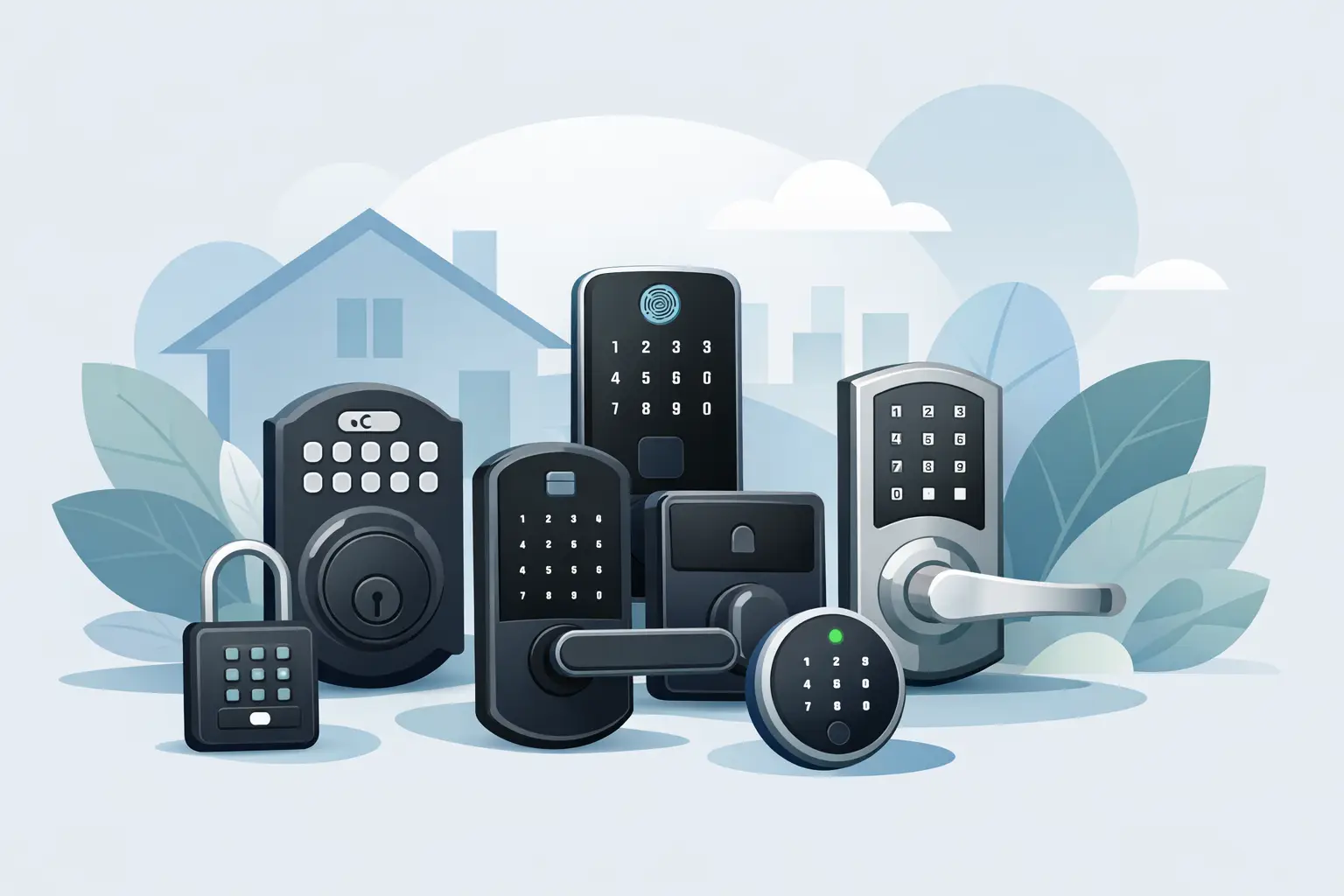

A keypad lock is a practical upgrade when you are tired of hiding spare keys, coordinating keys with family members, or wondering who still has access to your home. The best keypad locks for homes make everyday entry easier without asking you to sacrifice the security of a properly installed deadbolt. But the right choice depends on your door, your household, and how much smart-home technology you actually want to manage.
A keypad alone does not make a door secure. The lock body, deadbolt strength, strike plate, door frame, installation quality, and backup entry method all matter. For homeowners in South Florida, corrosion resistance and dependable operation through heat, humidity, and storm-season conditions matter too.
What Makes a Keypad Lock Worth Buying?
The best keypad lock is not necessarily the one with the most app features. Start with the basics: choose a deadbolt from a reputable manufacturer, look for a Grade 1 or Grade 2 ANSI/BHMA rating, and confirm that it fits your door thickness and backset. Grade 1 is generally the stronger residential option, while Grade 2 is suitable for many standard home applications.
For exterior doors, a keypad deadbolt is usually a better security choice than a keypad lever lock by itself. Lever locks are convenient, but the deadbolt should carry the primary security load. If your current door has a separate deadbolt above the handle, you can often replace only the deadbolt and keep the existing handle set.
Think about how your household enters the home. A simple electronic keypad deadbolt works well for a homeowner who wants code access without Wi-Fi, apps, or subscriptions. A connected smart lock can make more sense for frequent travelers, busy families, rental properties, or anyone who needs to create and remove codes remotely.
8 Best Keypad Locks for Homes by Need
These options are strong choices because they cover different needs, not because every home needs the same type of lock.
1. Schlage Encode Plus for Apple households
The Schlage Encode Plus is a leading choice for homeowners who use Apple Home and want phone or Apple Watch entry alongside a physical keypad. It also supports remote code management through its connected features. It is a premium-priced lock, but it combines a familiar deadbolt design with convenient access options.
This is a good fit for a primary residence with multiple family members. It may be more technology than necessary for a side door, garage entry, or a homeowner who prefers a basic code-only lock.
2. Schlage BE365 for simple, dependable code access
The Schlage BE365 is a non-connected keypad deadbolt designed for homeowners who want straightforward operation. You enter a code, turn the thumbturn, and lock the door manually when leaving. It does not rely on Wi-Fi, a mobile app, or a smart-home hub.
That simplicity is its advantage. There are fewer connected features to configure, and it remains a reliable option for a rental unit, secondary entrance, or anyone who wants to avoid carrying a key without adding smart-home controls.
3. Yale Assure Lock 2 Touch for fingerprint convenience
The Yale Assure Lock 2 Touch combines a keypad with fingerprint access, which is helpful when household members want quick entry without remembering a code or bringing a phone. It is especially convenient for active families coming home with groceries, sports gear, or children in tow.
Fingerprint readers should be treated as a convenience feature, not the only way to enter. Keep keypad codes active and make sure everyone who needs access understands the battery backup and emergency-entry plan.
4. Yale Assure Lock 2 Keypad for flexible smart-home setups
The keypad version of the Yale Assure Lock 2 offers a clean design and several connectivity choices depending on the model. It suits homeowners who want a modern smart lock but do not need fingerprint access.
Before buying, verify the exact connectivity version. Some models work through Bluetooth, while others support Wi-Fi or additional smart-home protocols. Choosing the wrong version is a common reason homeowners end up with a lock that does not work the way they expected.
5. Kwikset Halo Touch for remote access and fingerprints
The Kwikset Halo Touch gives homeowners a fingerprint reader, keypad, and Wi-Fi-enabled remote control in one unit. It can be a practical choice for people who want to check lock activity, add temporary codes, or let in a pet sitter while away.
As with any Wi-Fi lock, expect more battery use than a simple keypad model. Check batteries regularly and replace them before they become weak. Waiting for a low-battery warning to become an emergency is never a good plan.
6. Aqara Smart Lock U100 for connected-home users
The Aqara U100 is built for homeowners who want multiple entry methods, including keypad codes, fingerprints, and smart-home integration. It is often a good option for users already committed to compatible connected-home systems.
Its feature set is appealing, but setup requires more attention than a standard keypad deadbolt. If you want a lock that works with minimal configuration, a simpler electronic model may be the better purchase.
7. Lockly Secure Pro for code privacy
Lockly models stand out for their PIN Genie keypad, which rearranges numbers on the display. This can make it harder for someone nearby to identify your code by watching finger movements. Some models also offer fingerprint access and remote-management features.
The changing keypad is useful for homeowners concerned about visible code entry, though it can take a little longer to use. It is a sensible choice for a front door that gets regular foot traffic or for households that give access to multiple service providers.
8. Schlage FE595 for an integrated keypad lever option
The Schlage FE595 is a keypad lever lock that works well where convenience matters more than maximum exterior-door security, such as an interior garage door, home office, utility room, or a secondary door that is also protected by a separate deadbolt.
Do not rely on a keypad lever as the only protection on a main exterior entry unless the door and hardware setup are specifically designed for it. A dedicated deadbolt remains the safer choice for most front, side, and back doors.
Keypad Lock Features That Matter Most
A lock should make access easier for the right people and harder for everyone else. Prioritize a long, unique programming code and individual user codes whenever possible. Avoid using birth years, house numbers, addresses, or repeating sequences such as 1234. If a contractor, cleaner, or guest needs access, give them a separate temporary code rather than sharing your family code.
A physical key override can be reassuring, but it is also a potential weak point if the keyway is low quality or poorly protected. Key-free models eliminate the traditional key cylinder, but they require a clear battery backup plan. Many electronic locks allow emergency power from a 9-volt battery at external contacts, but homeowners should know how that procedure works before they are standing outside with a dead lock.
For a home near the coast or in high-humidity areas, choose hardware with a durable finish and inspect it regularly for corrosion. Salt air, moisture, and repeated rain exposure can affect both the finish and moving parts over time. A lock that works perfectly at installation can become difficult to operate if the door shifts, the bolt rubs the strike plate, or the hardware is not maintained.
Installation Is Part of the Security Upgrade
Even the best keypad lock for homes can perform poorly when installed on a weak door frame. The deadbolt should extend fully into a properly aligned strike plate, and the strike plate should be secured with long screws that reach the framing behind the jamb. If the bolt drags, sticks, or requires force to lock, correct the alignment instead of forcing the motor to work harder.
Measure your door before ordering. Most residential locks fit standard door thicknesses and backsets, but older homes, decorative doors, and metal doors can create exceptions. Also check whether the keypad will interfere with glass trim, a screen door, a storm door, or the existing handle set.
Professional installation is particularly valuable when you are replacing several locks, upgrading an exterior door, or combining keypad access with high-security hardware. General Locksmith can help homeowners select and install a keypad lock that fits the door correctly, then verify that the deadbolt, frame, and strike hardware work together as intended.
When a Keypad Lock Is Not Enough
A keypad lock improves convenience, but it cannot compensate for a damaged door, a loose frame, a weak strike plate, or an exposed sliding door. If you have recently moved, experienced a break-in, lost keys, or noticed that your door does not close securely, consider a broader security check rather than changing only the lock.
For higher-risk entry points, some homes benefit from reinforced strike plates, longer mounting screws, door viewers or cameras, better exterior lighting, and restricted-key or high-security cylinders. The right upgrade depends on the property, not a one-size-fits-all package.
Choose a keypad lock that your household will use correctly every day, then have it installed and tested with the same care you would give any other exterior security hardware. If your current lock sticks, fails to latch, or leaves you worried about who has a working key, call 954-243-1381 for reliable locksmith help 24/7.