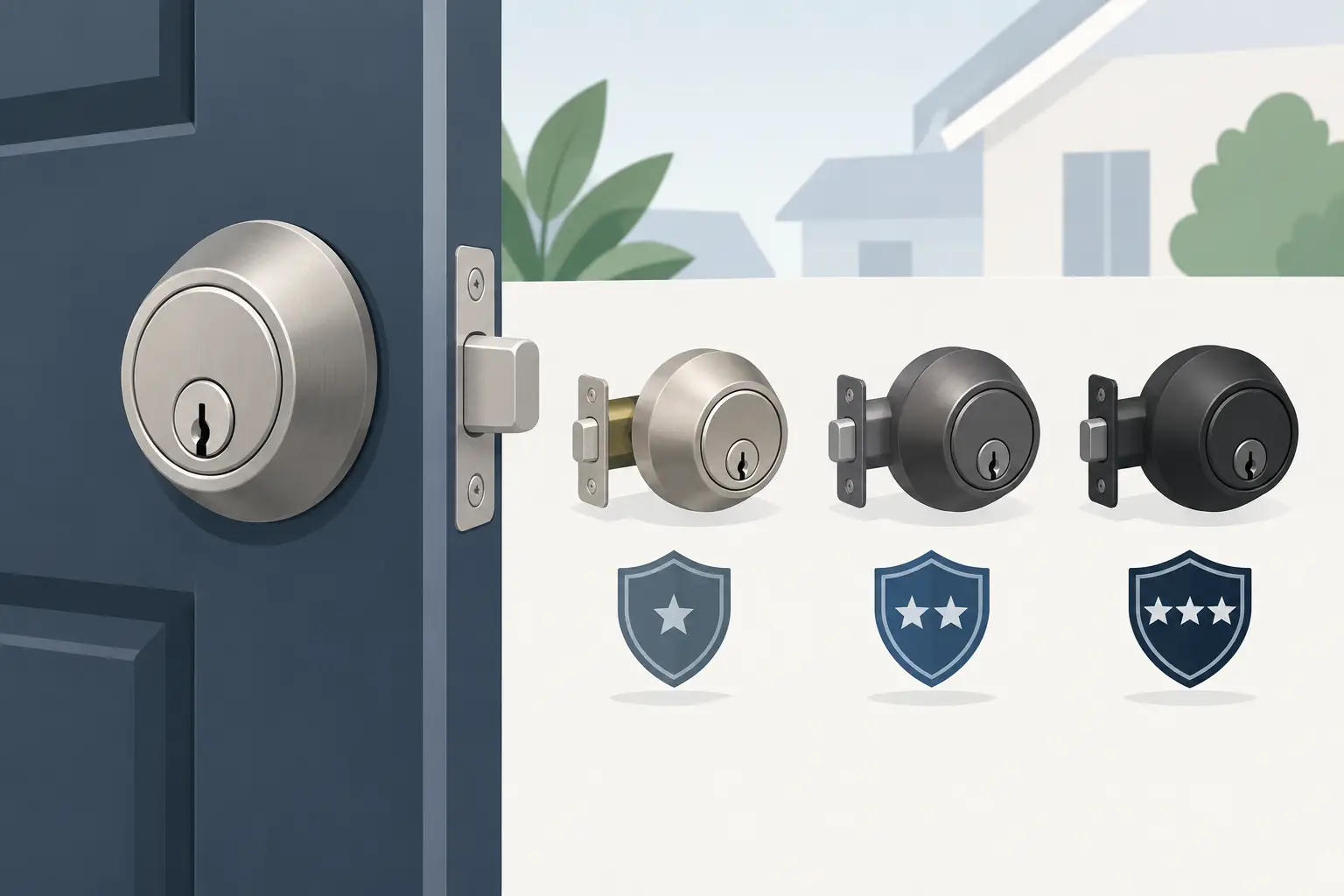

A deadbolt can look solid on a store shelf and still be the weak point on your exterior door. Learning how to choose deadbolt grades helps you look past the finish, keyway, and price tag to find hardware that can handle real use and real forced-entry attempts. For a South Florida home or business, the right choice also has to stand up to frequent use, humid conditions, and the strength of the door and frame around it.
What deadbolt grades actually measure
Deadbolt grades are performance ratings issued under ANSI/BHMA standards. ANSI is the American National Standards Institute, while BHMA is the Builders Hardware Manufacturers Association. Together, their testing evaluates how a lock performs under conditions that matter: repeated locking cycles, impact, torque, pull force, and resistance to common forms of forced entry.
The grade is not simply a label for “good,” “better,” or “best.” It reflects how the lock performed as a complete piece of hardware in controlled testing. A higher grade generally means the deadbolt is built for more demanding use and has passed tougher durability and strength requirements.
There are three common grades:
- Grade 1 is the highest standard and is commonly used on commercial doors, high-traffic entrances, and residential properties that need stronger protection.
- Grade 2 is a strong residential choice for many front, back, garage-entry, and side doors.
- Grade 3 meets a basic residential standard but is better suited to low-risk or light-use applications than a primary exterior entry.
A Grade 1 lock is not automatically necessary for every door. A seldom-used door in a well-secured condo has different needs than a rear service entrance at a business. The goal is to match the grade to the door’s exposure, use, and consequences if it fails.
How to choose deadbolt grades by door risk
Start with the door, not the package. Ask how often the door is used, whether it is visible from the street, whether it is near a secluded side yard, and what someone could access after getting through it.
For a primary front door, a Grade 2 deadbolt is often the minimum practical target. It provides meaningful strength for everyday residential use without the cost of commercial-grade hardware. If your home has a history of attempted break-ins, a concealed entry, or valuable property that makes it a higher-risk target, moving to Grade 1 can be a smart investment.
A back door, garage-to-home door, or side entry deserves the same attention as the front door. These entrances are often less visible, which can make them more attractive to an intruder. Installing a Grade 1 or Grade 2 deadbolt on these doors is usually more effective than placing premium hardware only on the front entrance.
For small businesses, offices, retail spaces, and storage areas, Grade 1 is often the better fit. Commercial doors experience more traffic, more keyholders, and more wear. A stronger deadbolt can help, but businesses should also consider key control, restricted key systems, access schedules, and whether staff need to exit quickly during an emergency.
Grade 1 vs. Grade 2 vs. Grade 3
The practical difference between grades shows up in strength and service life. Grade 1 deadbolts are designed to withstand heavier use and more aggressive force. They are a strong option for exterior commercial doors, high-traffic residential entrances, and doors where failure would create a serious security problem.
Grade 2 deadbolts are reliable for most homes. They are generally more durable and resistant to force than basic locks, while remaining available in a wide range of styles and price points. For many homeowners, a properly installed Grade 2 deadbolt on a solid door is a sensible security baseline.
Grade 3 deadbolts may be acceptable for low-priority doors, but they are not the first choice for a main entry. They can be tempting because they cost less, yet replacing a weak lock after a problem is usually more expensive and stressful than choosing better hardware from the start.
Keep in mind that a grade does not tell the whole story. A Grade 1 deadbolt with a weak cylinder, loose strike plate, or poorly fitted door can still leave vulnerabilities. It is one important factor, not a complete security plan.
Check the lock, the door, and the frame together
The deadbolt bolt should extend deeply into the strike plate and frame when locked. If it barely reaches the frame, the lock cannot deliver the protection its grade suggests. The strike plate should be heavy-duty and secured with long screws that reach the wall framing, not just the thin trim around the doorjamb.
Your door material matters too. A hollow-core door is not suitable for exterior security, regardless of the deadbolt grade. Solid wood, solid-core, fiberglass, and properly reinforced metal doors provide a stronger base. On older doors, misalignment can prevent the bolt from fully extending, causing premature wear and reducing security.
Look closely at the frame. Many forced entries defeat the frame or strike area rather than the lock itself. A reinforced strike, properly installed screws, and a door that closes squarely can make a major difference. This is why professional installation matters, especially when upgrading to higher-grade hardware.
Do not confuse a deadbolt grade with key security
A high ANSI/BHMA grade measures the lock’s physical performance. It does not automatically mean the key system is protected against unauthorized duplication or sophisticated manipulation.
For most households, a Grade 2 or Grade 1 deadbolt with a quality standard cylinder may be enough. For a rental property, office, medical suite, or business with multiple employees, key control may deserve equal attention. Restricted keyways and high-security systems can limit who can copy keys and can offer added protection against common bypass methods.
This is where brands and hardware lines can vary widely. A decorative deadbolt from a familiar name may have a good finish but ordinary key control. A security-focused cylinder from a manufacturer such as Medeco, Mul-T-Lock, or Primus may address different risks. The right setup depends on whether your primary concern is forced entry, uncontrolled key copies, employee turnover, or all three.
Choose the right deadbolt type
A single-cylinder deadbolt has a key cylinder outside and a thumb turn inside. It is the standard choice for many exterior residential doors because occupants can exit quickly without a key. It is generally the safest option for doors without nearby glass.
A double-cylinder deadbolt requires a key from both sides. Some property owners consider one when glass is close enough for someone to break it and reach the interior thumb turn. However, double-cylinder locks can create a dangerous exit delay during a fire or emergency, and local building or fire requirements may restrict them. Do not install one without confirming it is appropriate for the door and occupancy.
Keypad and smart deadbolts can add convenience, especially for rental homes, cleaners, vendors, or staff. Their mechanical components should still carry a suitable grade. Convenience features do not replace physical strength, proper installation, or a secure door frame.
Consider South Florida conditions before you buy
Humidity, salt air near the coast, and frequent rain can affect exterior lock hardware. Choose a finish intended for exterior exposure, and inspect the deadbolt periodically for corrosion, sticking, or loose screws. A lock that becomes difficult to operate is not just inconvenient. It may fail when you need it most.
For hurricane-prone areas, remember that a deadbolt is not a substitute for a rated impact door, proper shutters, or code-compliant protection. The lock secures the door to the frame, but the entire opening must be capable of handling severe weather conditions.
When a professional assessment is worth it
If you are replacing locks after a break-in, moving into a new property, managing several units, or securing a business, selecting a grade from a package alone can lead to gaps. A locksmith can inspect the door thickness, backset, frame condition, existing bore holes, latch alignment, and exit requirements before recommending hardware.
General Locksmith provides mobile lock installation and security upgrades throughout Broward County and nearby South Florida communities. For urgent lock issues or help selecting and installing the right deadbolt, call 954-243-1381. Licensed, insured, and bonded technicians are available 24/7, including weekends and holidays.
The best deadbolt is the one that fits the real risk at your door, works reliably every day, and is installed into a frame strong enough to support it. Start there, and the grade on the box becomes a useful security decision instead of a guess.